
(J. Paul Getty Museum; Album “E”: The Rincon Courtship, 86.XA.716.26)
“… and after a supper enlivened with fresh avocados we lay back against our rolled-up sleeping bags, stretched our feet to the fire, and lolled in indolent ease.[1]
Note: Unless stated otherwise, all photographs and archival materials illustrated in this post are currently owned, or were owned in the past, by Paul M. Hertzmann, Inc. All photographs by Edward Weston © Center for Creative Photography [CCP], University of Arizona.
Exploring Edward Weston and food without including his campfire cuisine would be akin to camping without a campfire. The topic surfaces everywhere, from personal writings to newspapers and periodicals to the narrative of such books as California and the West. Most unexpected of all? Weston’s unpretentious camping recipes—comprised largely of canned ingredients!—found their way into a decidedly sophisticated cookbook, Merle Armitage’s 1939 Fit for a King.
Weston relished camping—hardly surprising since it offered a deep connection to nature, minimized travel expenses and satisfied his lifelong preference for simplicity in all things. From the earliest days in Tropico through his subsequent life in Carmel, Weston sought and invariably found inspiration in the outdoors. Yet, access to both nature’s intimate and sweeping photographic possibilities often required forays into remote and rugged terrain where amenities were few and far between. These conditions, especially relevant during his Guggenheim Fellowships (1937–1939) and Limited Editions Club Leaves of Grass (1941–1942) journeys, influenced not only his art, but his approach to travel.
Camping emerged as an integral element of Weston’s California life soon after his arrival in Tropico from Chicago in 1906. It even played a role in his courtship with his first wife, Flora Chandler, who seems to have shared Edward’s affinity for the outdoors. The Los Angeles Sunday Times reported on one such trip in August 1907:
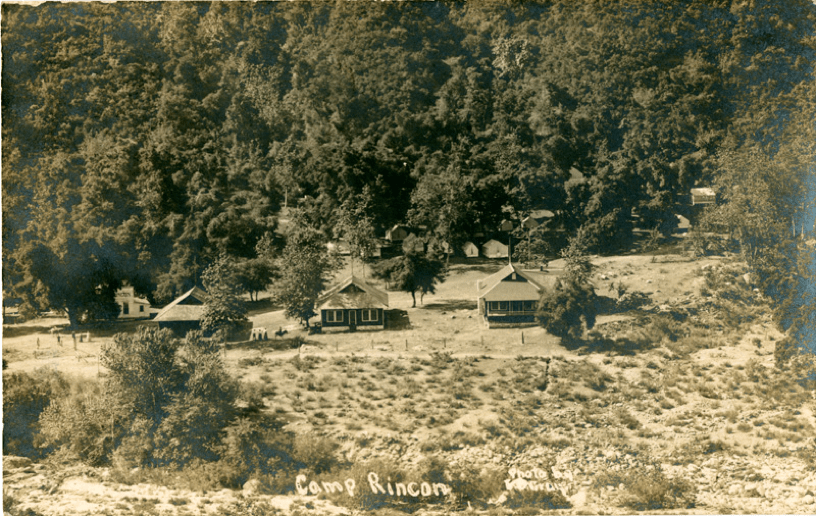
Miss Flora Chandler and Miss Emily Ellias accompanied by their cousin, Mr. Edward Weston, joined a camping party Saturday, composed of Los Angeles friends, chaperoned by Mr. and Mrs. W.A. Packard, who left for Rincon Camp in the San Gabriel Canon. Later Miss Fannie Marple will join this camping party.[2] [Note: Emily Ellias was actually Flora’s niece; Weston was not related to either Flora or Emily.]
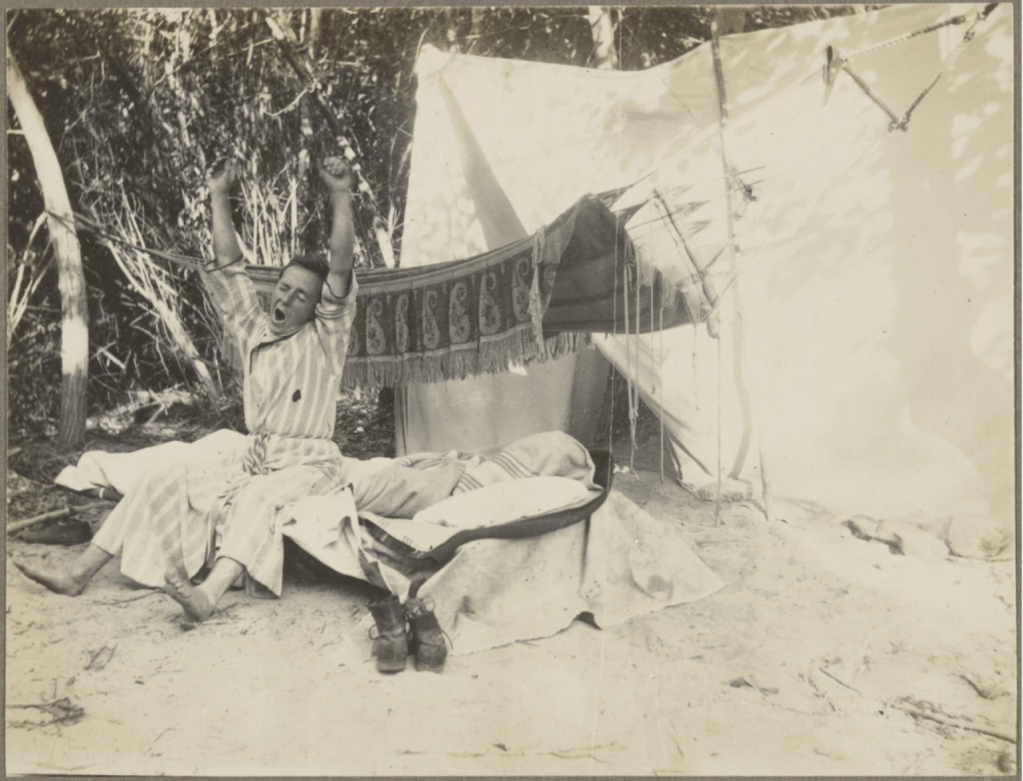
(J. Paul Getty Museum; Album “E”: The Rincon Courtship, 86.XA.716.27)
Camp Rincon—a popular retreat in the San Gabriel Canyon—boasted a variety of features, from tents (furnished and unfurnished) to fresh food, a dining hall, and a music/dance pavilion. Guests could avail themselves of trout fishing, hiking, horseback riding, a pool, tennis and croquet. We don’t know which amenities Weston and friends utilized, but they clearly enjoyed a modicum of creature comforts on their trip. These included tents, cots, blankets and pillows; a hammock for sleeping beneath the stars or lazying away an idle hour; rustic tables and wooden crates for dining, seating and storage; cooking, cleaning and laundry supplies; and a guitar, books and magazines for campsite entertainment. Snacks and meals remained close at hand thanks to food in jars, tins and bottles while a camp stove facilitated the preparation of hot meals. What the majority of those meals consisted of is unrecorded, but the title of one photograph tells us pea soup was on the menu!
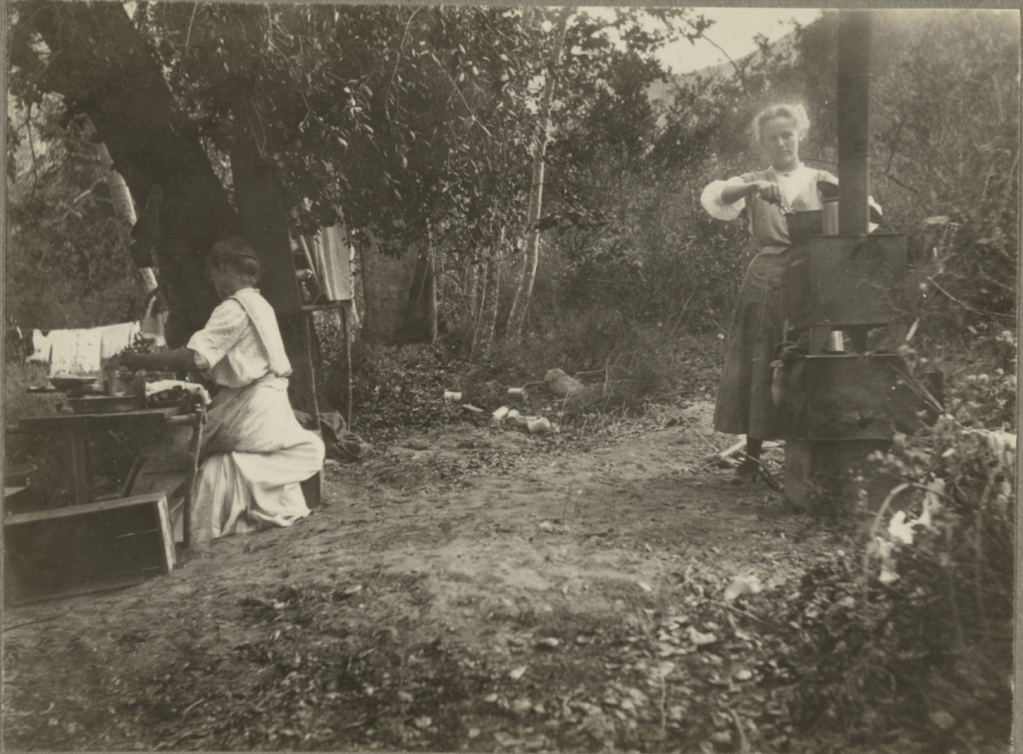
(J. Paul Getty Museum; Album “E”: The Rincon Courtship, 86.XA.716.31)
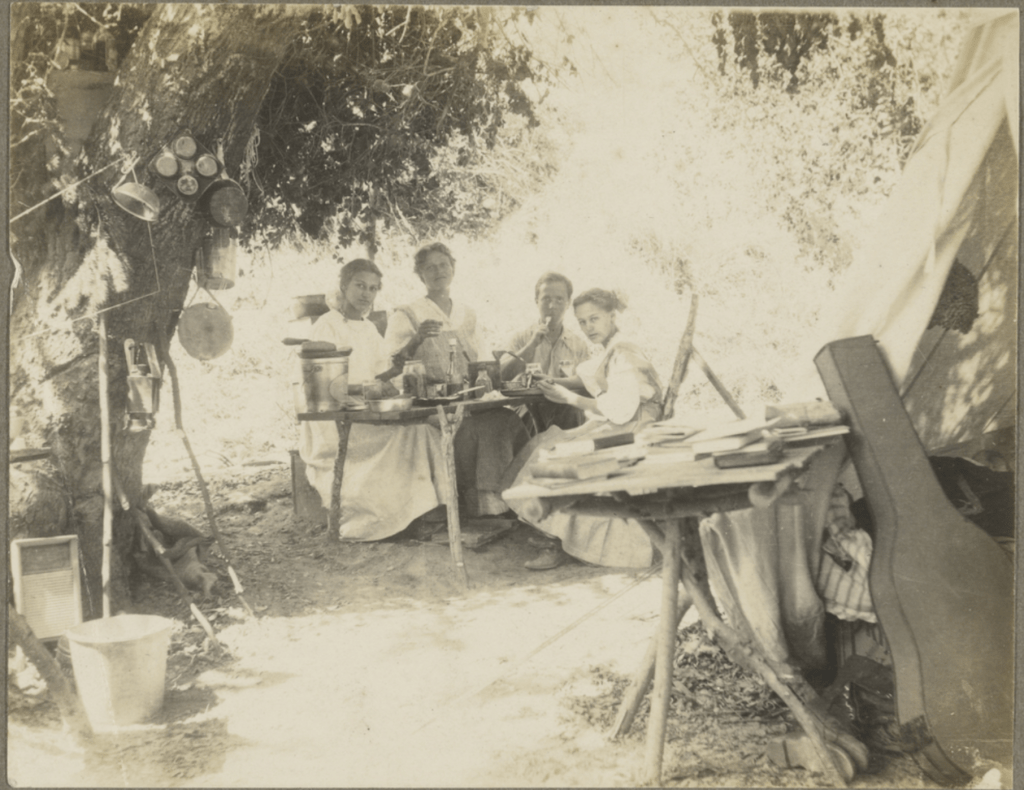
(J. Paul Getty Museum; Album “E”: The Rincon Courtship, 86.XA.716.33)
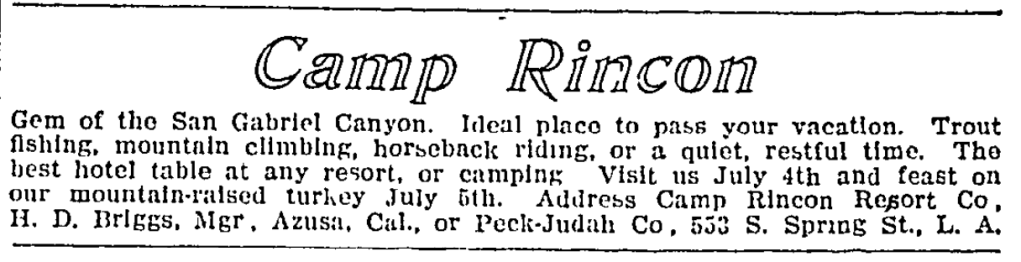
(California History Room, California State Library)
A few months later, the friends commemorated their outing with a faux camping party described by The Glendale News on 19 October:
Miss Flora Chandler, Miss Lillian Ellias, Miss Fannie Marple, Miss Emily Ellias, Mr. Albert Marple and Mr. Edward Weston attended a party in Los Angeles, given by Mr. and Mrs. A.W. Packard at their residence Thursday evening at which the guests were members of the camping party Mr. and Mrs. Packard chaperoned while at Camp Rincon, the past summer. The guests, twenty-five in number, were seated around a supposedly real camp fire, such as they enjoyed while in camp, and related camp life anecdotes and adventures. The refreshments were served camp fashion and consisted of the savory viands which apepase [sic] the appetites of the campers. Host, hostess and guests were attired in the khaki suits.[3]
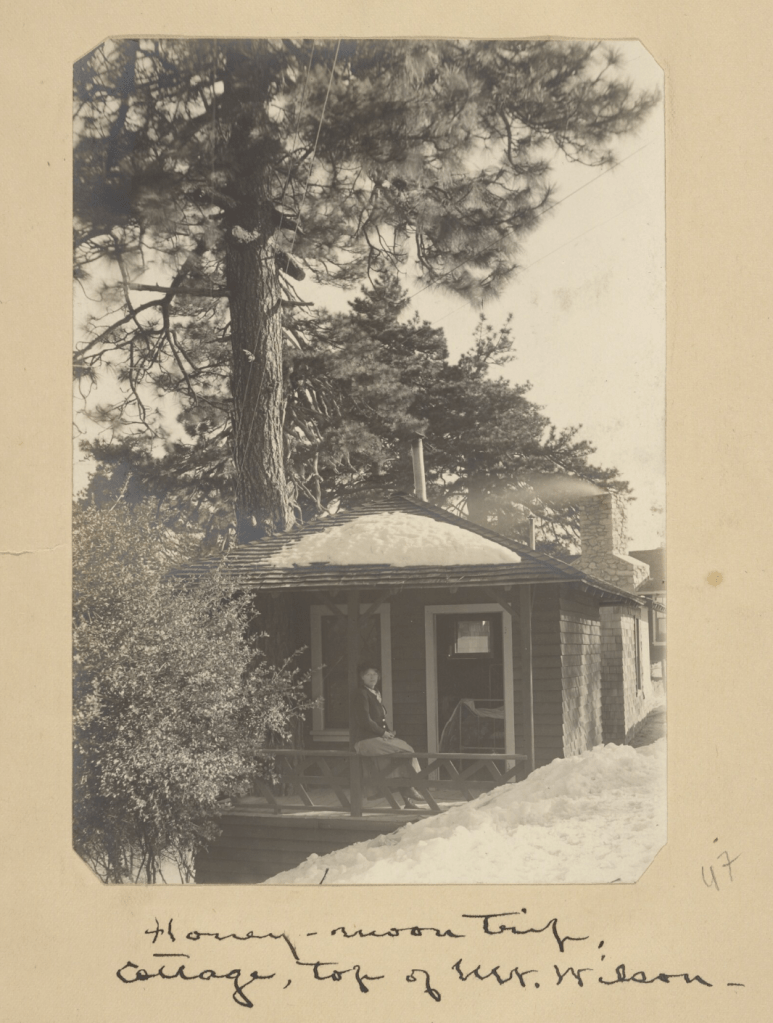
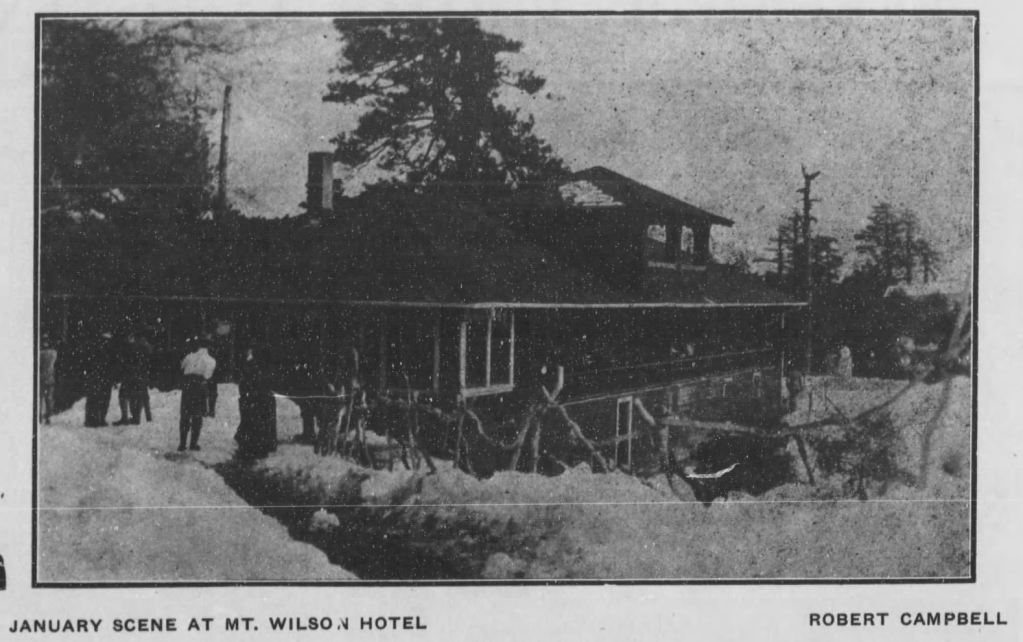
By December 1907, Edward and Flora were engaged,[4] although the wedding did not take place until January 1909.[5] Appropriately enough, the couple celebrated their honeymoon in the nearby San Gabriel mountains. This time they opted for a cabin at the top of Mount Wilson, likely one offered by the Mount Wilson Hotel. Weston’s snapshot of Flora on their cottage porch, as well as a 1909 Los Angeles Herald photo of a “January Scene at Mt. Wilson Hotel,” picture a glorious snow-laden locale for their winter idyl.
(J. Paul Getty Museum; Album “C.” 86.XM.719.17)
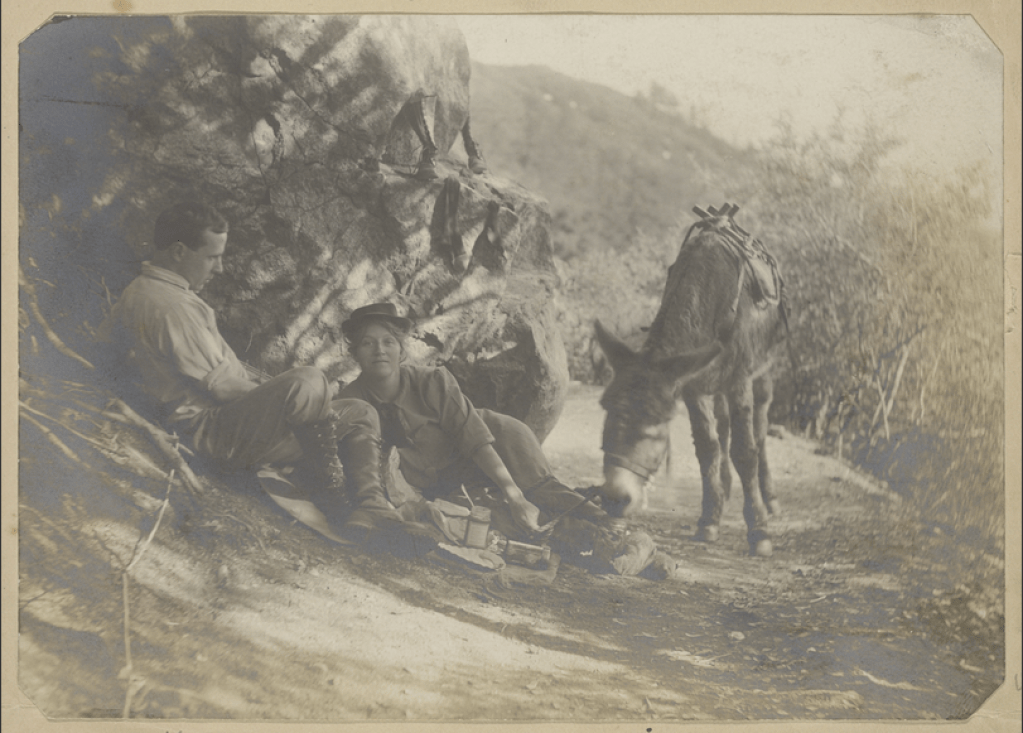
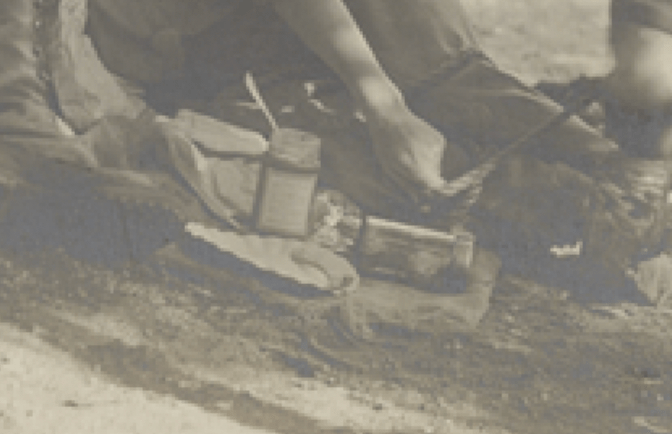
During their stay, the honeymooners likely dined at the hotel and/or in their cottage, but while out exploring they chose fare similar to that on their earlier camping venture. In a self-portrait (Weston’s shutter release cable is evident at lower left), Edward, Flora and their burro pause for refreshment on a mountain trail.[6] Visible in the foreground are a spoon in an open jar, a box or tin of what appear to be crackers, and a paper plate—a disposable convenience only recently introduced into popular usage.
(J. Paul Getty Museum, 86.XM.719.16)
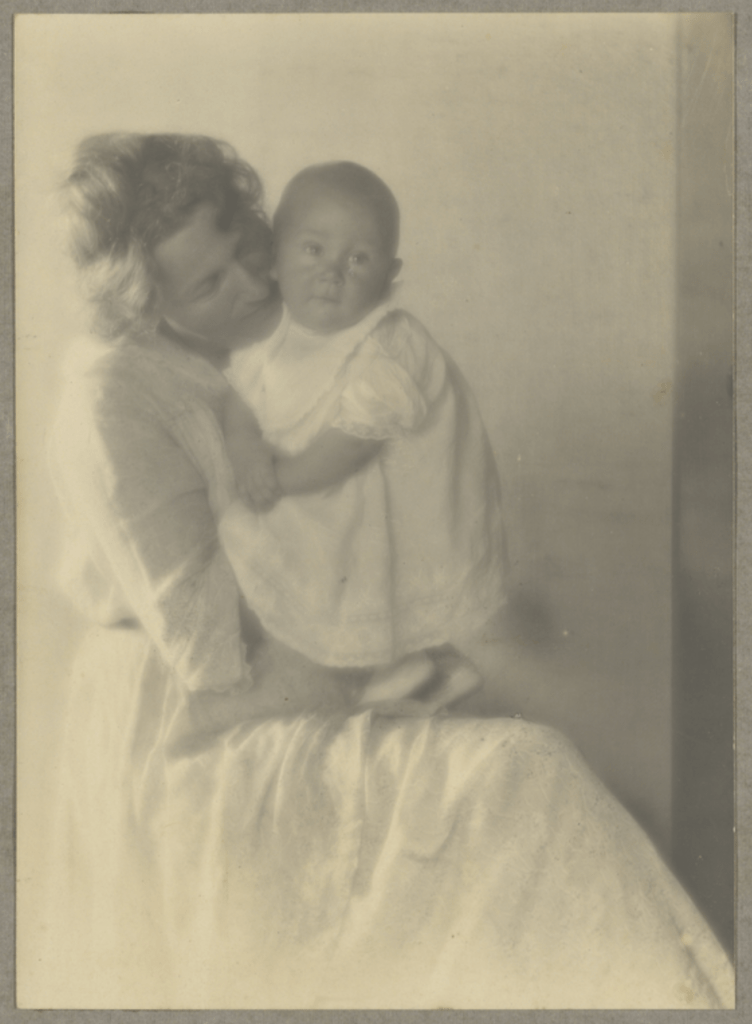
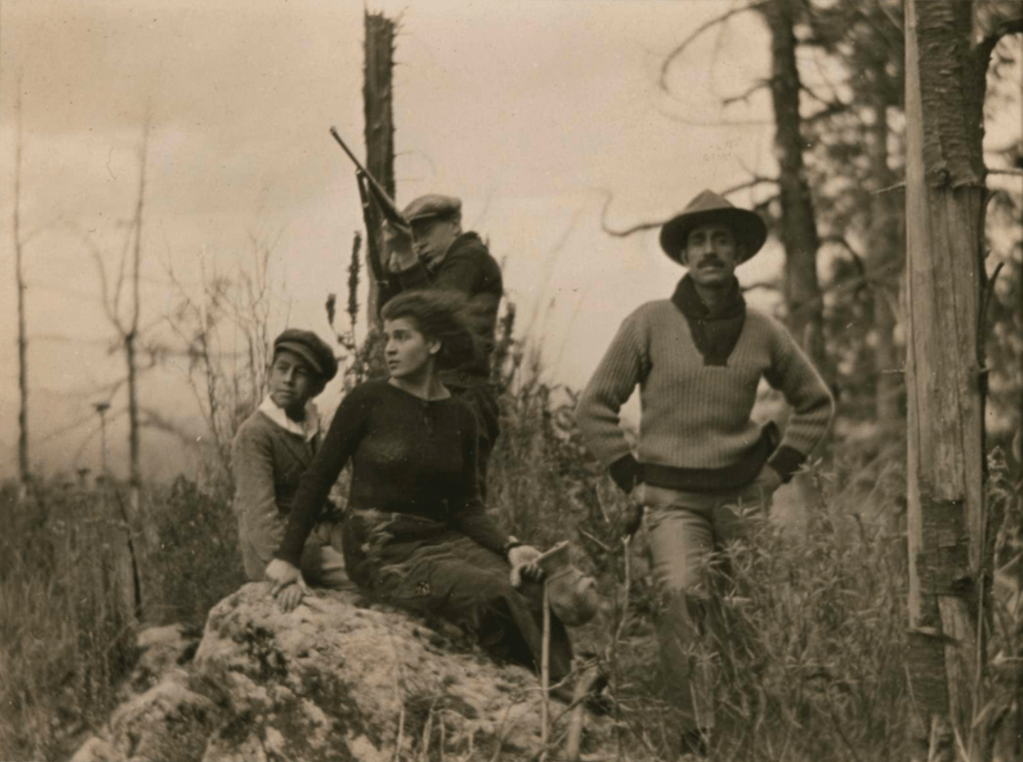
Weston’s partiality for camping continued throughout the decade. On 19 July 1917 The Tropico Interurban Sentinel revealed one such trip, a weeks-long expedition to Lake Tahoe: “Mr. Edward Weston went to Lake Tahoe last week with three Los Angeles friends for a month’s outing. They will travel in two automobiles equipped with all camping paraphanalia [sic].”[7] Unlike earlier excursions, no family member participated. Weston’s marriage was floundering and with two young children and an infant at home it would have been difficult for Flora to take part anyway. Alas, no photographs from this trip have been identified, nor (as tempting as it is to speculate), are the names of the “three Los Angeles friends” known.
(J. Paul Getty Museum, 89.XA.23.34)
What we do know is that the campers enjoyed fresh-caught trout—that most classic of camp food—along the way. On 2 August, The Tropico Interurban Sentinel reported:
Mr. Edward Weston returned Sunday night from his camping trip with Los Angeles friends and reports a delightful tour in all respects. Stops were made at Lake Tahoe, at Placerville and Monterey. Splendid time was made on the return journey, their auto covering 250 to 300 miles a day. No big game was shot, but they caught some fine mountain trout and made camera shots which were well worth while.[8]
OUTDOOR LIFE IN MEXICO, GLENDALE AND SAN FRANCISCO
Camping evidently played a minor role in the next significant period of Weston’s life—his time in Mexico from 1923–1926. At least no such activity is reflected in his Mexican Daybooks. Instead, during his photographic forays to various cities, villages and surrounding countrysides, he and his companions generally stayed at local hotels or the homes of friends. The reasons may have been two-fold: the comparative affordability of local accommodations and, less positively, the inadvisability of camping in locales affected by political unrest. Yet, the pleasure of dining around a campfire was not wholly abandoned, as seen in this description of a robust meal Weston recorded in January 1924:
Sunday. Tina, Chandler, and Edward: Galván [Manuel Hernandez Galván] invited us to join him for an outing. In a high powered car, sixty miles an hour, we climbed the road to Toluca. Up, we roared … through old towns, then into pineclad mountains. Once we were stopped by soldiers, ready for action, and significantly reminded of the revolution. But a flourish of Galván’s pass, and recognition of a general amongst us, changed the surly attitude to a salute. / Lunch under the pines—tortillas, hot from the ashes of a bonfire, frijoles y carne—beans and meat—and plenty to drink—tequila y cerveza—beer. …[9]
(Eastman Museum; 1974.0061.0145)
After returning from Mexico in 1926 and re-establishing himself in Glendale (Tropico was annexed in 1918), professional and personal demands likely left little time for camping. Still, Weston’s desire for outdoor escape and al fresco dining continued, as reflected in this brief comment of 11 April 1928:
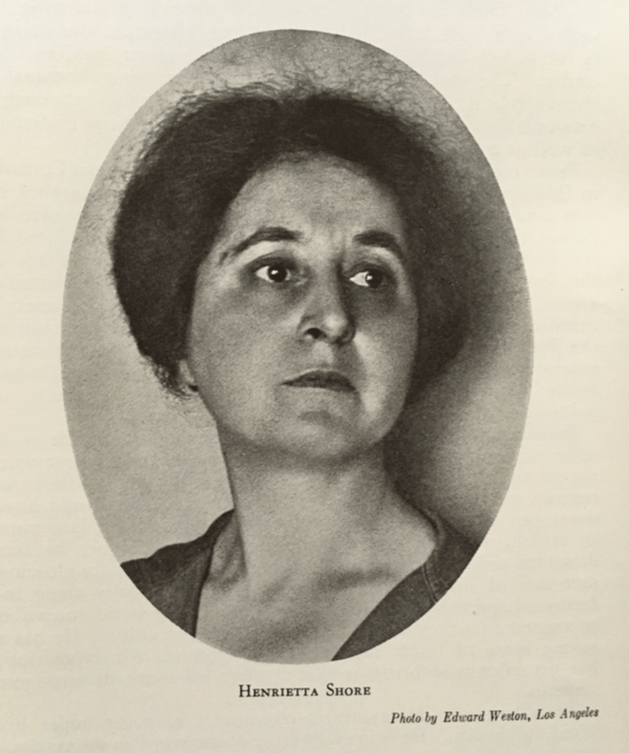
One fine day last week Henry [artist, Henrietta Shore], Brett [son, Brett Weston], and I packed cameras, paints, lunch, and went to Santa Monica for work and outing. I had grown tired of “still life,” of confinement,—I wanted air and soil. Santa Monica was chosen because of a fine group of sycamore trees.”[10]
In August 1928, Edward and Brett migrated north for a hiatus in San Francisco where, in October, they shared a different type of outdoor experience—this one aboard a yacht sailing around San Francisco Bay as the guest of Dr. Leo Eloesser.[11] Eloesser’s hospitality was unstinting but, as usual with regard to food, Weston’s preferences led him to decry the prevalence of what he considered rich campsite meals over such minimal fare as fruit, nuts and his perennial favorite, avocados. On 1 October he confided to his Daybook:
Saturday night Brett and I sailed away on the yacht Flirt,—guests of Dr. Eloesser. We had never met the doctor,—he knew us only through the East West exhibit [East West Gallery, San Francisco, 1–22 July 1928], where he purchased two prints. He took a chance, inviting strangers, and we likewise as guests of a stranger. However, the night and day passed amicably enough. / I said we “sailed.” The sails were raised but only flapped in a gentle breeze, and gasoline took us to the night’s anchorage, far up the bay. A full moon shone,—when not befogged,—through floodlight into gloom we hugged the shoreline,—changeful, restful hours. To bed at 2:—, up at 7:00. Breakfast on the beach. Pork sausage and fried apples, cake, jam, and coffee. Washing greasy dishes in the ocean, hunting firewood,—a disagreeable waste of time! How differently Brett and I alone would have done it. Fresh and dried fruits, Brazil nuts, pecans, maybe an aguacate [avocado] apiece,—we have found them quite inexpensive up here—then the waste overboard! / A roaring bonfire on the beach to gather around for good cheer—yes!—for frying apples and pork sausage—no! Destroying the flavour and goodness of a delicious apple, eating a dead pig! Well, we are the abnormal ones, cranks I suppose. The doctor enjoyed it and went out of his way to give us a good time. / The memorable hour of the day was after a dip in the bay,—loafing on deck naked in the sun and wind. What a tonic for weary minds and bodies! I hope to plan my life so that one hour every day can be spent naked in sunlight.[12]
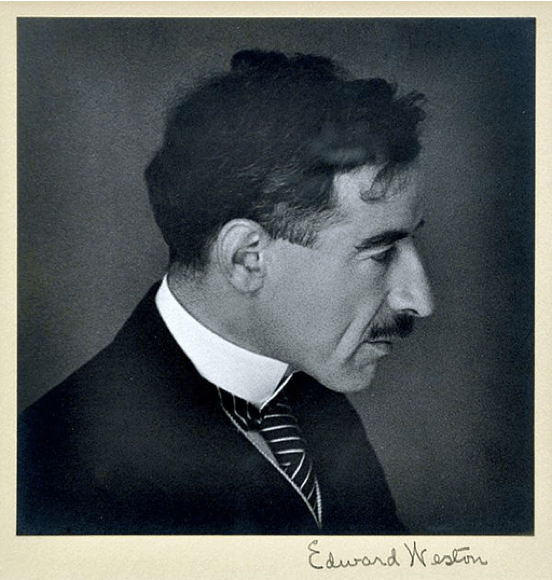
(The Volunteer, blog post of the Veterans of the Abraham Lincoln Brigade)
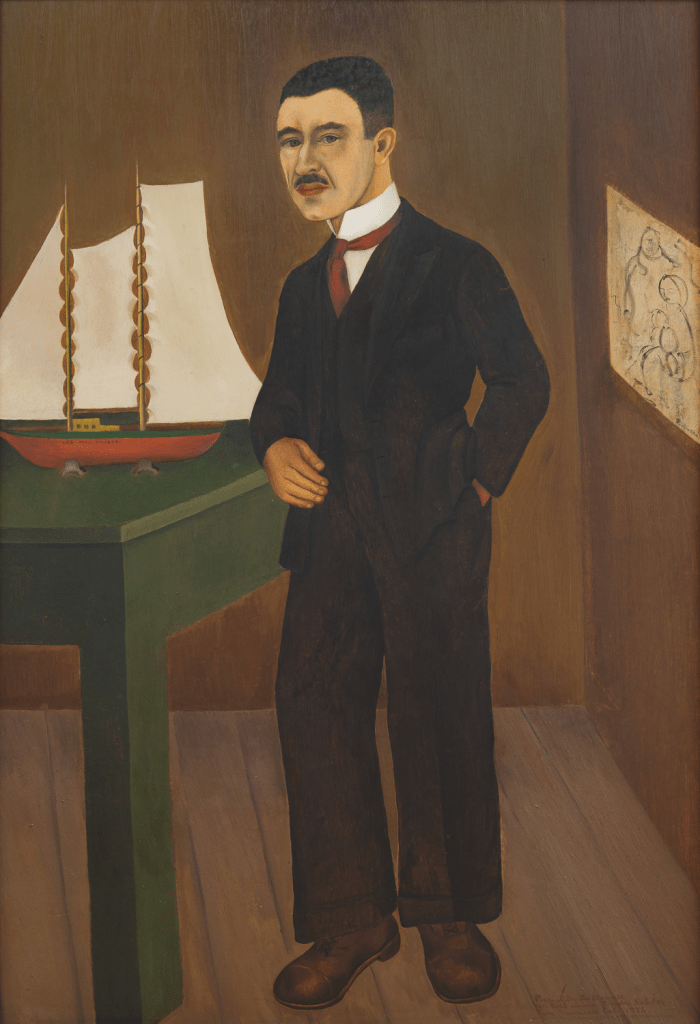
(University of California San Francisco, Zuckerberg San Francisco General Hospital and Trauma Center)
Dr. Eloesser was a close friend of Diego Rivera and Frida Kahlo as well as Kahlo’s physician. In this portrait, Eloesser is depicted with a model of his yacht “Los Tres Amigos.”
CROSS-COUNTRY CAMPING: THE GUGGENHEIM & LEAVES OF GRASS PROJECTS
Weston finally broke free from the bonds of family responsibility in Glendale with a move to Carmel in January 1929. Except for brief interludes, this picturesque, culturally vibrant coastal enclave would remain his home for the rest of his life. Here, the rugged, inspirational beauty of nature was close at hand, minimizing the need for camping and travel. Not until 1937, when Weston embarked on the Guggenheim project, did both become truly integral to his artistic pursuits.
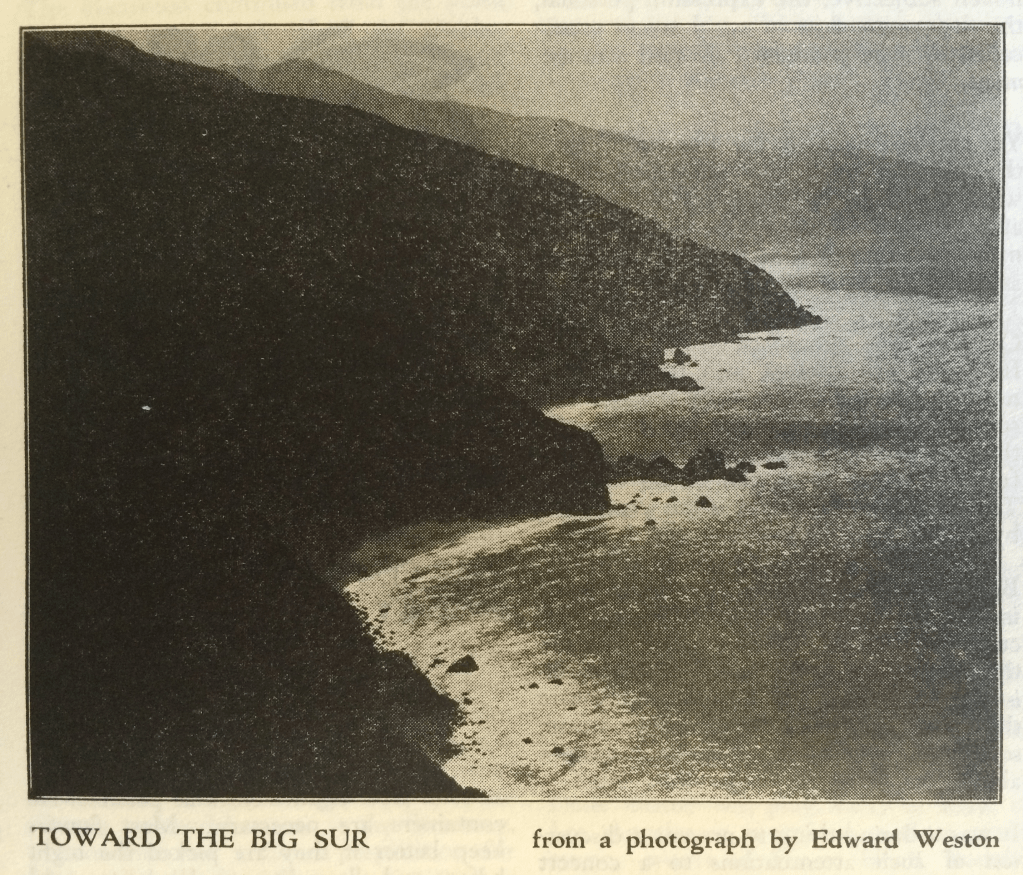
The demands and stark simplicity of the Guggenheim travels stand in marked contrast to the breezy ease of Weston’s earlier Tropico camping experiences. The focus was now on photography—food and equipment had to be efficiently streamlined and adaptability became a critical underpinning for success. Nancy Newhall contrasted Weston’s modern methods with those of his 19th century expeditionary predecessors in a 1947 article for Photo Notes:
Edward Weston on his journey through the West on his Guggenheim Fellowship introduced certain modern improvements into the classic tradition of the frontier photographers, Jackson and O’Sullivan. Instead of the mules, a new Ford; instead of salt beef or game, canned foods stewed over the campfire; instead of the dark tent, a tarpaulin thrown over the roof of the car at night, while he crawled inside to change film.[13]
Throughout the Guggenheim years, Weston, Charis Wilson (whom he married in 1939) and an occasional friend or family member traversed the country in “Heimy,” their 1937 Ford V-8, crammed together with photographic equipment, camping gear, provisions, and clothing. (For a detailed look at one such foray, see my post of 16 December 2020: “Traveling with Edward Weston: Through the Eyes of Willard Van Dyke.”)
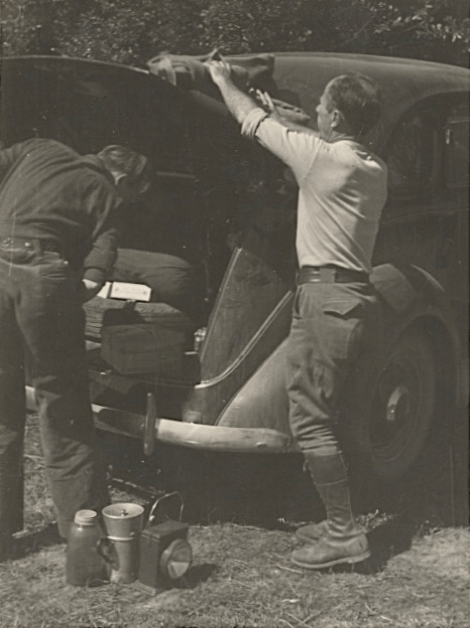
(Collection of Paul M. Hertzmann, Inc.)
Of course, road travel in the 1930s would have been much more difficult without the benefit of our present-day super-highways, all-terrain vehicles, GPS, cell phones and sophisticated camping gear. Equally consequential were the tight financial constraints occasioned by the Great Depression, making preparedness and adaptability primary considerations. In “Photographing California [Part 1],” published in the February 1939 issue of Camera Craft, Weston described the bare necessities of food, clothing and equipment allotted:
… / The first and most important item was a car. Since I don’t drive there was always at least one other person along. Considering the bulky equipment to be carried, we decided to get a touring sedan, and by luck I was able to get a new one rather than the second-hand one my budget allowed for. In a less reliable car I would never have risked some of the cow tracks we have been over. Other equipment consisted of sleeping bags, tent, gasoline stove, cookset, shovel and axe, two 2-gallon canteens and a pint one, thermos bottle, drycell lantern. / … / When there was enough to do to keep us in one place several days we usually put up the tent so as to have a place to leave the bulk of our equipment. / … / In the mornings we were usually up at dawn. Often I would work until dusk and we would have to scramble for a camping place in the gathering darkness. But only twice in the summer and fall months were we thwarted in finding one and forced to turn to auto camps for shelter. … We carried none of the usual camper’s culinary necessities: flour, bacon, etc. Time was too important to be wasted on cooking. We had one hot meal at night, a stew, made by combining the contents of several cans. During the day we would have any number of snacks as hunger dictated and for these we took Swedish bread and whole wheat crackers / (which do not mould or dry up as bread would), a whole Monterey jack cheese (which ripens beautifully in changing climates), nut-butter, jam, honey, powdered milk, and dried fruits. At the start of a trip and when we passed through towns these were supplemented with fresh fruit and milk, butter, eggs, etc. Neither did we allow time off for wash days, but carried sufficient changes of clothing to get us through the whole trip. / I have gone into these facts at some length simply to stress this point: without such thorough simplification in our daily living I could not have made the twelve hundred negatives. … [14]
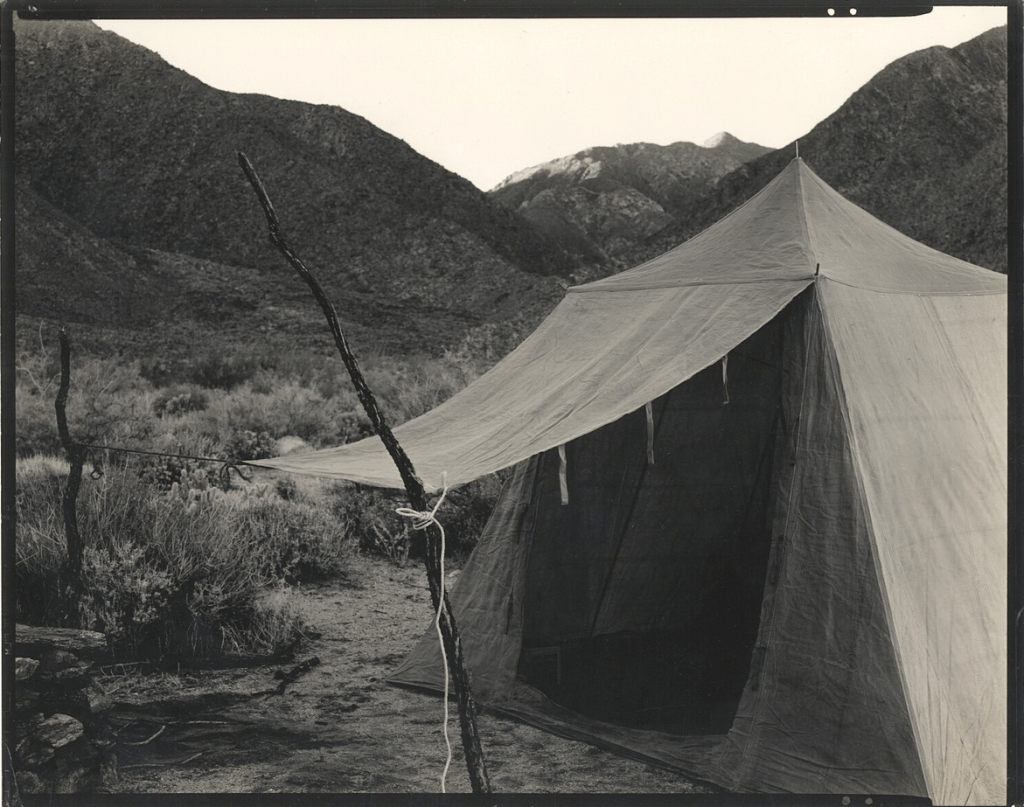
(Collection of Paul M. Hertzmann, Inc.)
Charis echoed and elaborated Weston’s remarks in her Foreword to California and the West, the engaging, beautifully illustrated chronicle of the Guggenheim venture published in 1940:
Food becomes a passionate interest when you are moving around. As described in the book, we started off each day with a quick bracing cup of coffee. Breakfast usually came at midmorning, after a couple of hours of work or driving, and lunch set in whenever hunger called for it. We equipped ourselves with dried fruit and nuts to tide us over between meals. Edward considered it a sin to waste good daylight by cooking, so we usually took our ready-to-eats in hand or aluminum cup—dry cereal, canned or fresh fruit, crackers, cheese, nut butters, sardines. The secondary function of these meals was to break up the long days and bring us together for some rest and talk. … A typical stew recipe called for: a jar of chicken egg noodles, cans of corn, tomatoes and tamales, with some jack cheese melted on top. Any surplus was stored in the jar and added to the next night’s stew. … / The simple fare was relieved by local specialities along the way, such as date milk shakes, fresh lake trout, or the nearly black locust honey we discovered one day in a grocery in Julian. Then, too, there was the odd bit of luck, such as the memorable feast we had just after New Year’s 1939 at the fashionable Furnace Creek Inn in Death Valley. The proprietress, a capable-looking gray-haired lady named Miss Ronan, had asked Edward to show prints to her guests. Despite our rough desert attire—the only clothing we had—she insisted that we return the following night as dinner guests. From the lordly bill of fare, we selected delicacies such as cream of artichoke soup, broiled lamb chops, sirloin of beef, creamed spinach, and fell upon the meal with appetites enlarged by two weeks of camp life. There was no check but we paid for it after all.[15]
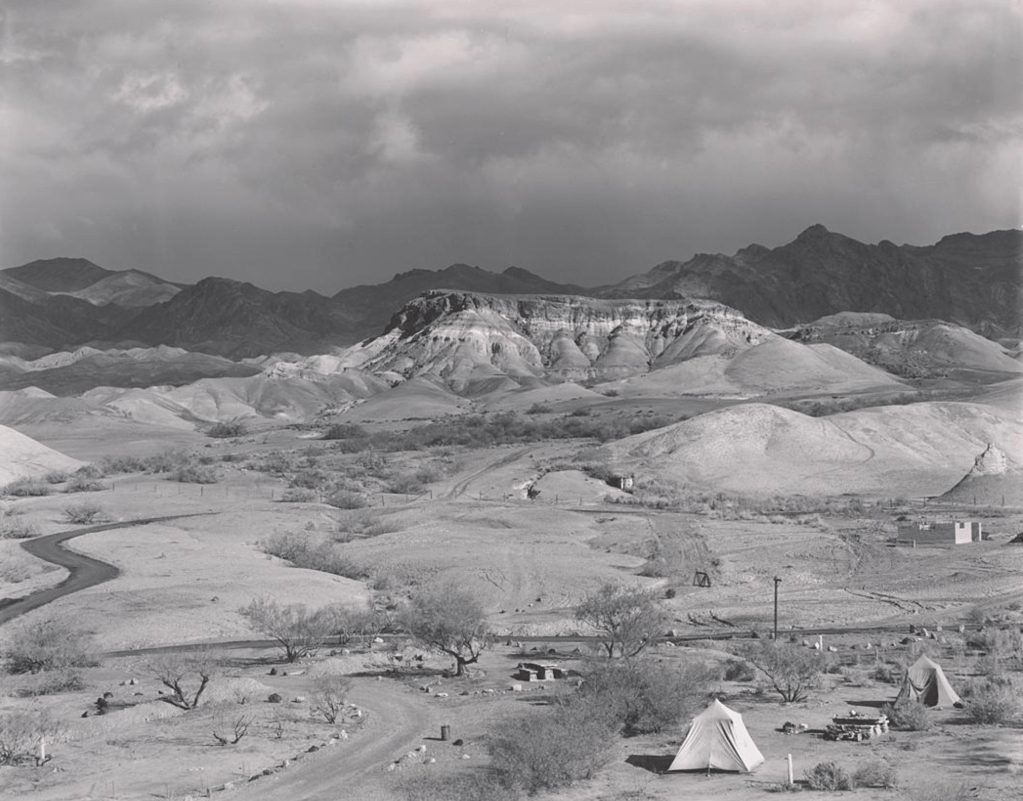
(Center for Creative Photography 81.251.79)
Even the best laid plans could and did run afoul of capricious environmental conditions. One such misadventure in the Mojave Desert reflects their need for resiliency:
At sundown the breeze increased to a cold steady wind. We gathered sticks, built a fire in the shelter of the rocks, and by its heartening glow consumed our first camp supper. Edward climbed into Heimy to un- and reload his film-holders, while Cole and I draped the windows with blankets and sleeping bags weighted down with provisions. Just as everything was well secured the wind, which had relented for a while, gave a sudden blast—the draperies flew off and boots and canned goods went clattering down a gully in the dark. For the duration of the darkroom period, Cole and I were obliged to stand on the running boards holding down the covers with numbing fingers. / … / Five o’clock in the morning is a chill hour on the Mojave when no thinking person would get out of a warm sleeping bag, except he be beguiled by the aroma of hot coffee—especially Weston coffee, for Edward’s technique with that sensitive beverage is equalled only by his way with a camera.[16]
Weather wasn’t the only challenge to daily work and dining routines. Weston’s creative impulses could also prove disruptive. To ward off resulting daytime hunger, the travelers equipped Heimy with a food box filled with quick, fortifying supplies:
Cameras would be packed into the car, we would drive for perhaps three minutes, then Edward would say, “Wait a minute! I’ve got to take a look at this!” He would take his look, come back saying almost apologetically, “I’m afraid I’ll have to do it.” Out would come the cameras, one rock or Joshua would lead to another, and half an hour later the performance would be repeated. Five hours from breakfast we were not yet five miles from it. / I should explain here that I use “breakfast” to designate the first of the morning’s repasts: fruit, or fruit juice, and coffee. During the day we had no regular meals. On top of the back-seat load we kept a food-box containing a variety of crackers, dried fruits, cheese, nut butters, and jam. If we had recently passed a store, there would be fresh fruit, lettuce, and milk; if not, here were cans of fruit, asparagus, sardines, etc., to vary the basic menu. When the need arose—and it did with amazing frequency—we would repair to the food-box singly, or together. Our appetites were so violent that we seldom dared to stray twenty steps from Heimy without first filling our pockets with dried fruit against a sudden seizure. …[17]
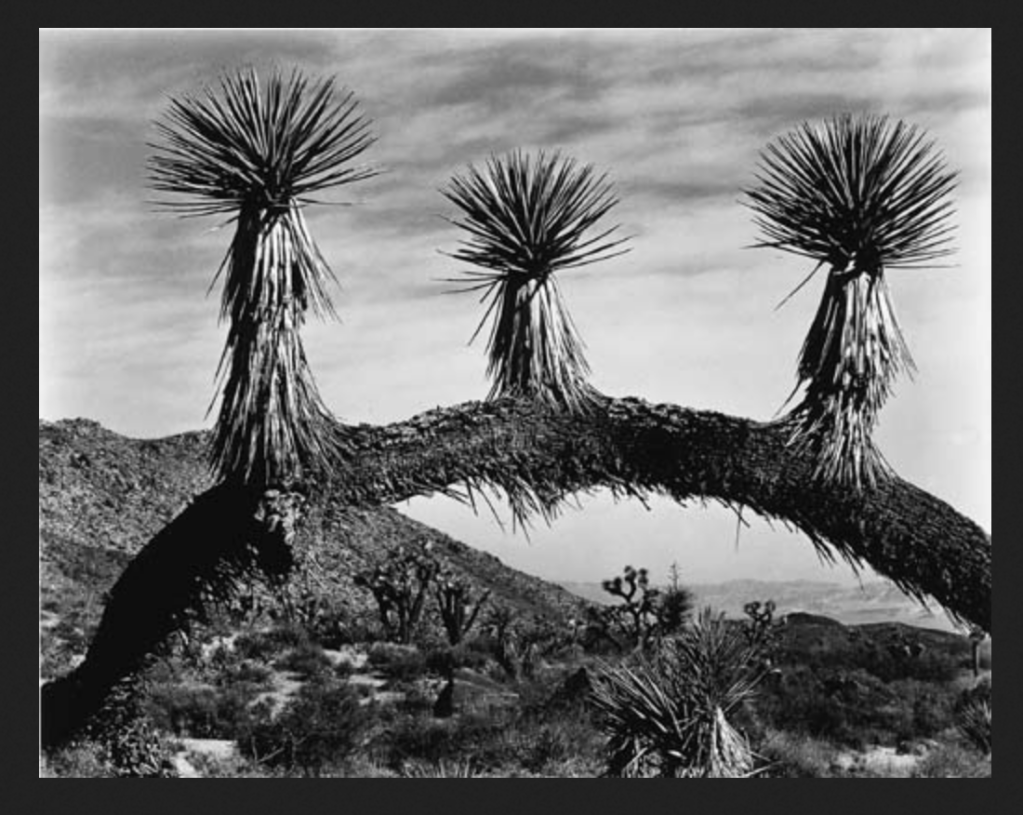
(Christie’s Photographs, Sale 9324, 17 January 2001, Lot 198)
California and the West captures memorable episodes of this momentous two-year journey. It is a revelatory visual and written record replete with serendipity, vicissitude, inspiration, comradeship, and exceptional creativity—even moments of haunting sensory enchantment:
Presently the road climbed a low hill and we looked down on a desert Eden. Cupped between dry rocky ridges lay a little vale carpeted with grass and edged by a half dozen fat shade trees. It took us several minutes to be convinced this was indeed the dry lake. There was a cactus-less gravel flat against the ridge for our campsite and all the flowers that ever grew on a desert bloomed around it. / … / Back through the yellow forest to our enchanted camp to watch the orange sunset-light climb up the cactus-studded hill behind us. / The air was blandly warm and still and full of lower scents. A banquet was in order, and out of a mysterious birthday box it came: stuffed olives, pickled onions, antipasto, camembert cheese, marinated herring, and a whole salami! Too warm for a fire, so half a moon came up to light the feast while a cricket chorus provided incidental music. We made an extra pot of coffee and filled the thermos for an early morning start, then lay on our sleeping bags watching the moonlight wash over the landscape, dropping neat pools of inky shadow under the trees. / At dawn the air was still warm—the thermos coffee cold. No matter; we drank it that way, and dashed off for negatives of the agave-stalked hill in sunrise light. …[18]
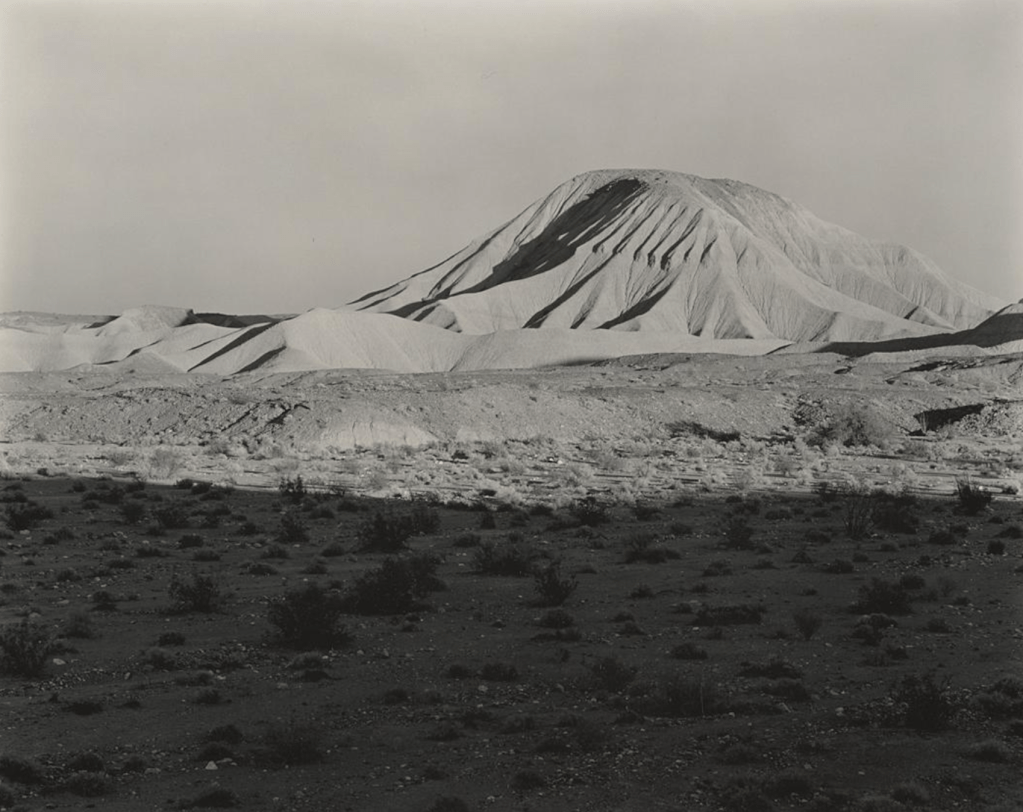
(Center for Creative Photography 81.278.17)
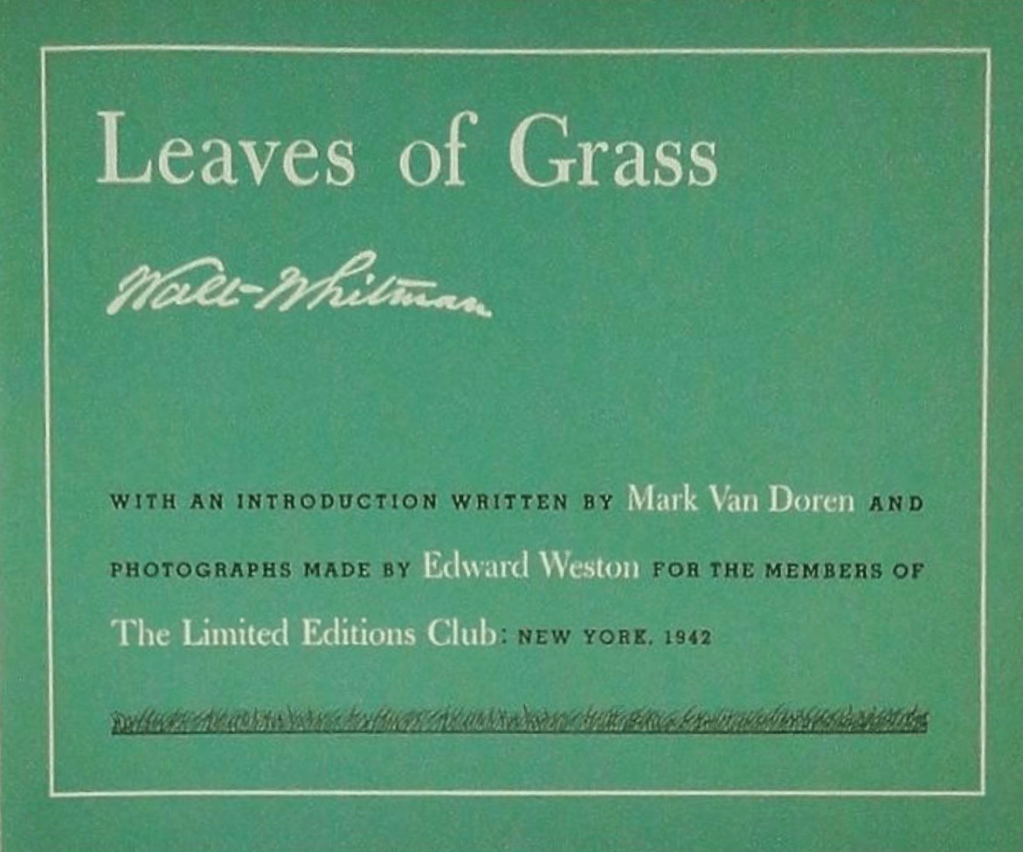
Weston’s Guggenheim adventure served as a practical prelude for his next major enterprise—a commission from the Limited Editions Club for a new version of Walt Whitman’s Leaves of Grass, illustrated with his photographs. Traversing 20,000 miles and twenty-four states with Charis from May 1941–January 1942, Edward photographed people, landscapes and places he found resonant with Whitman’s vision, but not necessarily illustrative of the classic verse itself (an approach which caused George Macy, director of the Club, much consternation). While visiting Tucson in June 1941, Weston expressed his resolve to a reporter for The Arizona Daily Star:
Edward Weston, one of America’s outstanding photographers, has arrived in Tucson to make a series of pictures in this region which will be included in a limited edition of Whitman’s “Leaves of Grass.” … / Weston said yesterday that the edition “will not try to recall Whitman’s day, but be the America of today since his writings went far beyond any specific region or time.” The photographic collection Weston will make in the next six or seven months while touring the nation will be of people and places, anything which represents America of today. / …[19]
Accommodations and food preparation during the Whitman project deviated from those of the Guggenheim days. Edward and Charis continued to travel by automobile, but in a newly acquired Ford they nicknamed the Good Gray Bard. Like Heimy, the Bard was densely packed with equipment, staples, and such ready-to-hand provisions as crackers, cheeses and prepared foods. Unlike the Guggenheim, on the Whitman trip they largely abandoned camping in favor of auto camps and motels. Such lodgings offered greater convenience and comfort than did their former trailside encampments. Meals were often taken at cafes, hotels and picnic spots. Charis provides a snapshot of one such experience in this letter to friends Donald and Beatrice Prendergast, whom they’d first met in New Orleans during August:
Friday September 19th 1941 / Middletown to Cambridge Ohio / 7 PM. Autocamp out of Cambridge, can, shower, innerspring mattress, –$1.50. Out of season price most like. Ohio has roadside parks with picnic tables like Texas and unlike Texas with privies. Everything for the traveller. We were sitting in one lunching on triscuits and cheese and lettuce and olives today, just out of Circleville birthplace of General Sherman? on US22. … [20]
Charis’s memoir, Through Another Lens: My Years with Edward Weston, details the advantages of auto camps and cafe dining. Here she describes their stay at the Albers Auto Camp outside of the Port Arthur Oil Refinery in Texas:
Watkins [a photographer and member of the Chamber of Commerce] would set us up with a guide in the morning and meanwhile recommended Albers Auto Camp just east of town, a two-dollar emporium that spoiled us for the rest of our travels. My journal describes it: ‘Fresh white paint, tile shower, fine kitchen, with Frigidaire with ice cubes with bottle of ice water all awaiting us. The furniture is clean and the bed is good, the curtains are clean, even the windowsills are clean and that is something that never is in any auto camp. There is a wastebasket, a garbage can, a good dressing table with mirror, an easy chair covered in fresh white, a clean closet, kitchen table, three-burner gas ring. / Watkins, known as J.C., came over in the evening to see prints, and in the morning we had breakfast with him at the Goodhue Hotel across from the Chamber.’[21]
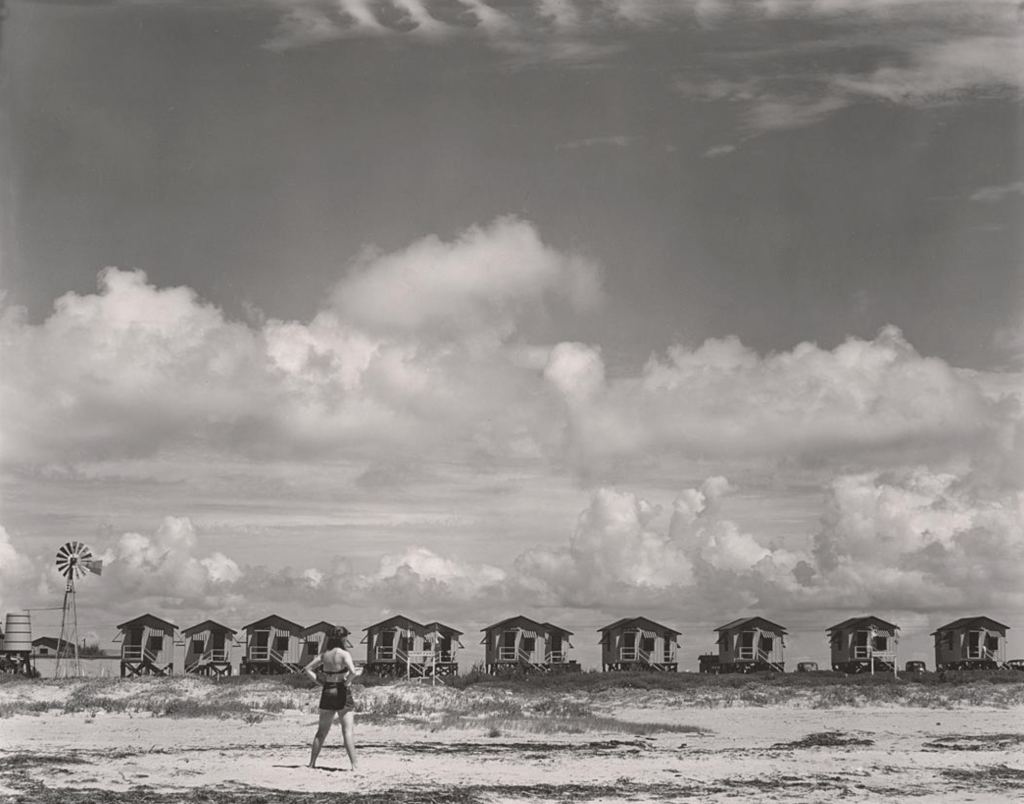
However, the following July 1941 experience in Galveston, Texas proves that all auto camps and motels weren’t quite so salubrious:
The autocamps [sic] on the seawall were priced out of sight. Our first inquiry got a $5.00 quote; our second—for a little hole-in-the-wall—was $2.50. Outraged, we continued several miles along the seawall to where cars could drive at the water’s edge and Sunset Beach Camp would supply us with a raised tent-house for $1.50. We did not hesitate, because there was still time for a swim. … / … We woke the next morning drenched with sweat and unable to move in the furnace-like heat of the shack. We had slept late after a fitful night of suffocation and mosquitoes. Dragging ourselves down to the water, we crawled through the shallows and were sufficiently revived by the Gulf soup so that Edward returned for his camera and made a negative of the beach nuts with swimsuited me in the foreground.[22]
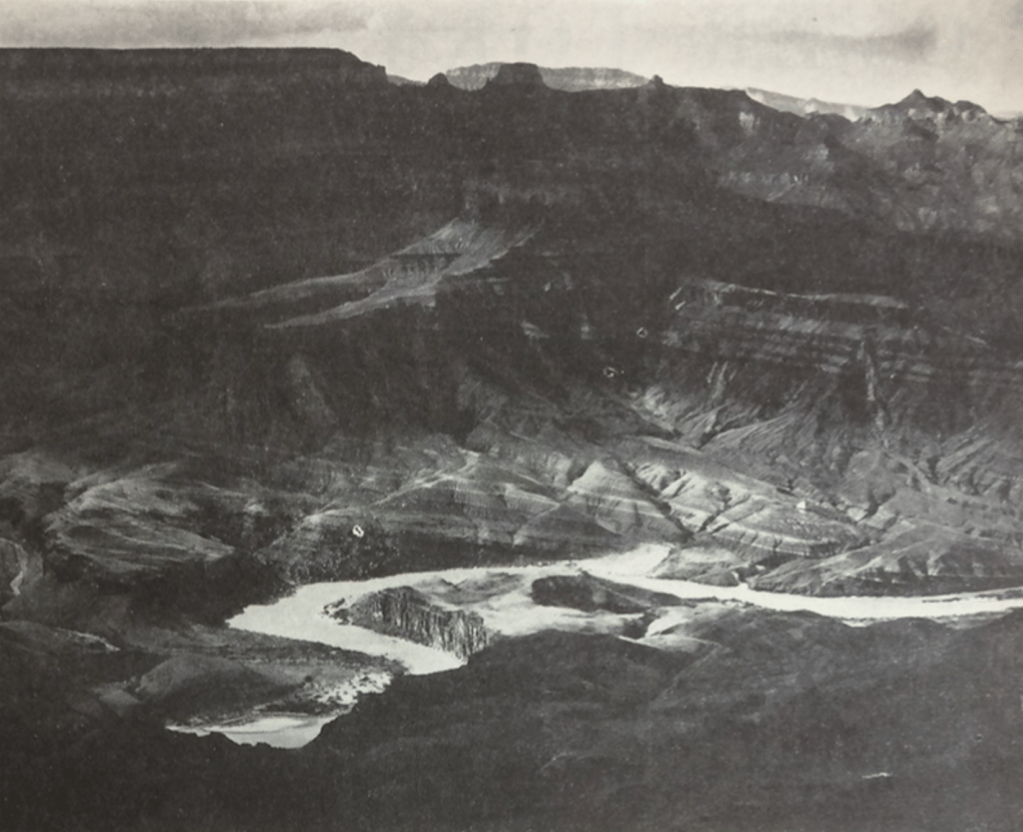
Fortunately, grim experiences such as the one in Galveston were occasionally offset by deluxe accommodations elsewhere. For example, while photographing the Grand Canyon in June 1941, Edward and Charis stayed at the Bright Angel Lodge where, according to Charis, they were “…put up and fed in style…compliments of the Atchison, Topeka, and the Santa Fe Railroad. … We spent a week driving up and down the west rim and then the east rim in wet and hazy weather, looking into the canyon from all available viewpoints, and returning at night to excruciatingly comfortable quarters.[23]
To economize, the travelers preferred to stay at the homes of friends or the friends of friends whose hospitality was secured by letters of introduction. Financially beneficial, these home stays also provided a welcome degree of comfort and good food. In her memoir, Charis describes how painstakingly she organized these references:
Recognizing that the pay was insufficient to cover nightly motel fees, even if they were modest two-and three-dollar affairs, we decided that the only solution was to alert everyone we knew along the way about our plans and hope that hospitality would shower down. We compiled a monstrous file of names. Some were friends, some were on Edward’s list of people who had bought work, and some were fellow Guggenheim veterans recommended my Moe [Henry Allen Moe]. I typed the list onto separate pages for each state—38 pages in all—and made an alphabetical file of the states so I could organize correspondence with potential hosts and have space to add phone numbers and directions.[24]
In another letter to the Prendergasts, written in August 1941 from Abe Lincoln’s Auto Camp in Vicksburg, Tennessee, Charis opined for the warm reception and delicious meals recently received at their home: “… In the cabin dinner of lettuce, cheese and triscuits, missing our wonderful “P’Gast meals. My God: are we spoiled! …”[25]
A month later, the couple were equally well cosseted at the Bradford, Pennsylvania home of Weston’s patron, Edward T. Hanley. Charis offers this account of their first night’s dinner there:
It was the end of September when we arrived at Ed Hanley’s big house in Bradford, New York [sic; the home was in Bradford, Pennsylvania]. Hanley was a successful businessman who had visited us in Carmel and owned a number of Edward’s prints. He was out of town but had left instructions for his English housekeeper, Elizabeth Wilson, to take care of us. She fed us dinner at the groaning board, and it wasn’t much more than a board, being maybe four feet long and two wide. Ham steak drowned in butter, baked potatoes, creamed onions, fresh peas, soup, biscuits, salad. Hanley must have told her to feed us well, and she thought that meant we were members of the Donner Party. We ate by dim light among antiques, to the sound of opera on the radio while Elizabeth stood at the end of the table…[26]
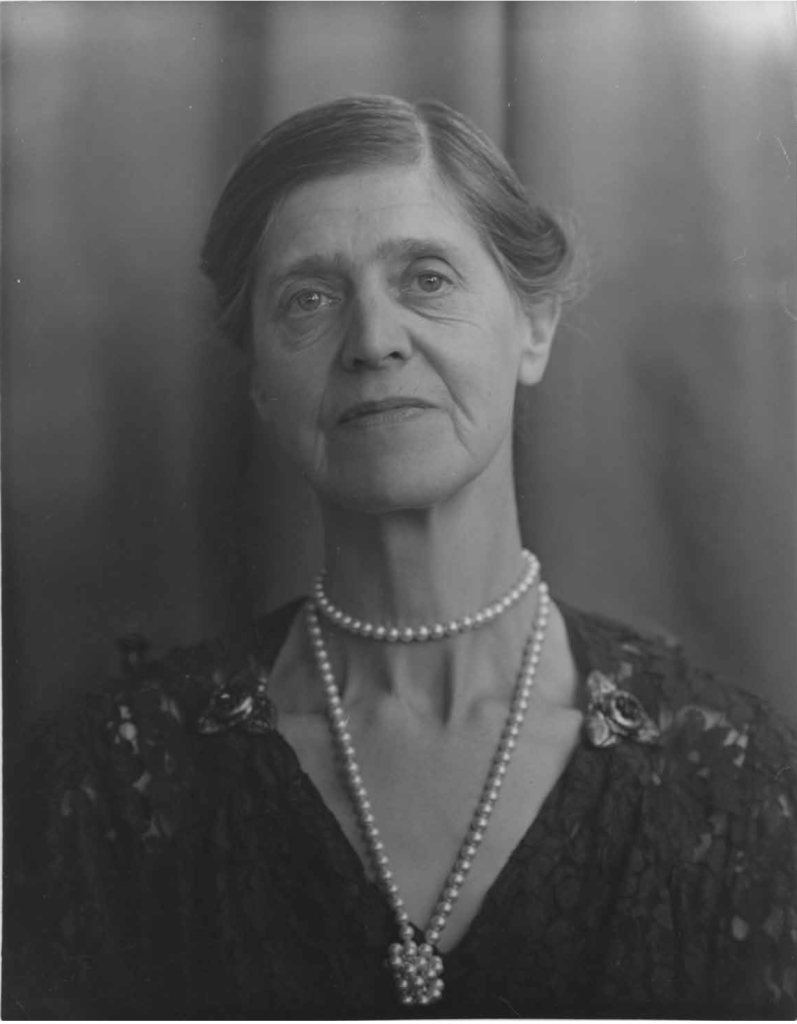
(Estate of Charis Wilson, inherited by her daughter, offered for sale by Jonathan Clark, Los Altos, California, 2015)
Different approaches to accommodations and dining may have characterized the Guggenheim and Whitman projects, but both proceeded under undeniably disturbing shadows. For the Guggenheim it was the Depression, for the Whitman it was the looming threat of war and a national state of emergency. In the case of the Whitman trip, the 7 December 1941 attack on Pearl Harbor put a hasty end to their creative venture. Yet, on both journeys the travelers’ indomitable spirit, patience and ingenuity carried them through triumphs and travails with spectacular artistic results, results that endure in Weston’s masterful photographs and Charis’s written accounts.
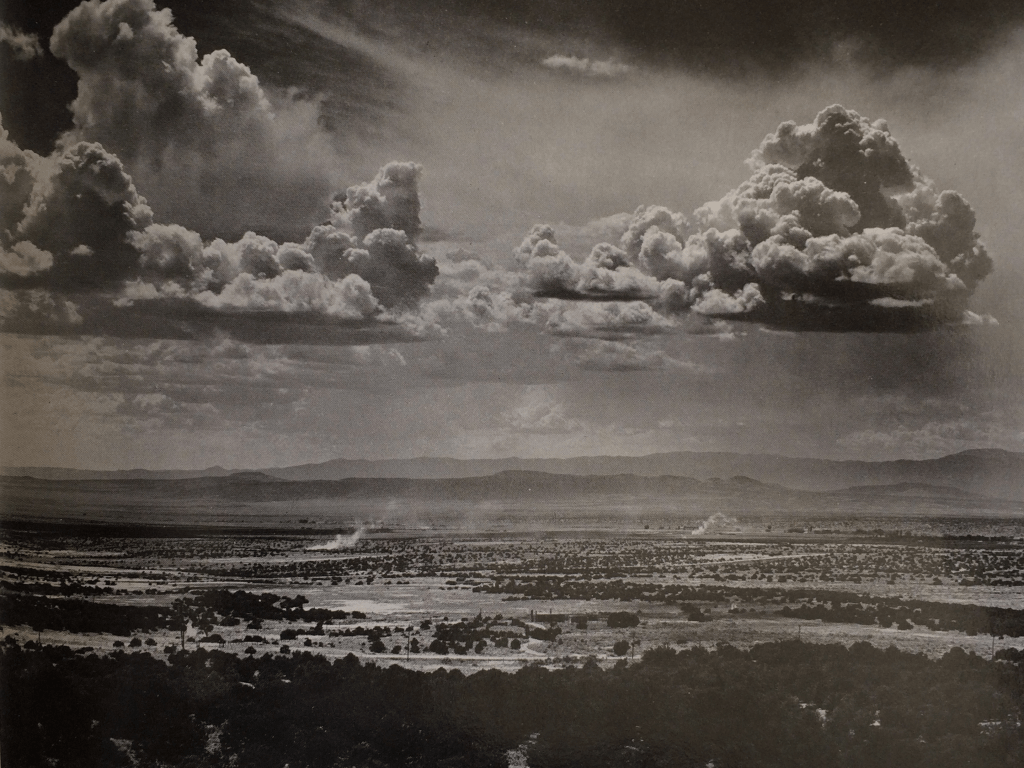
Illustrated in Leaves of Grass, Vol. 1, opposite p. 82.
“FIT FOR A KING”
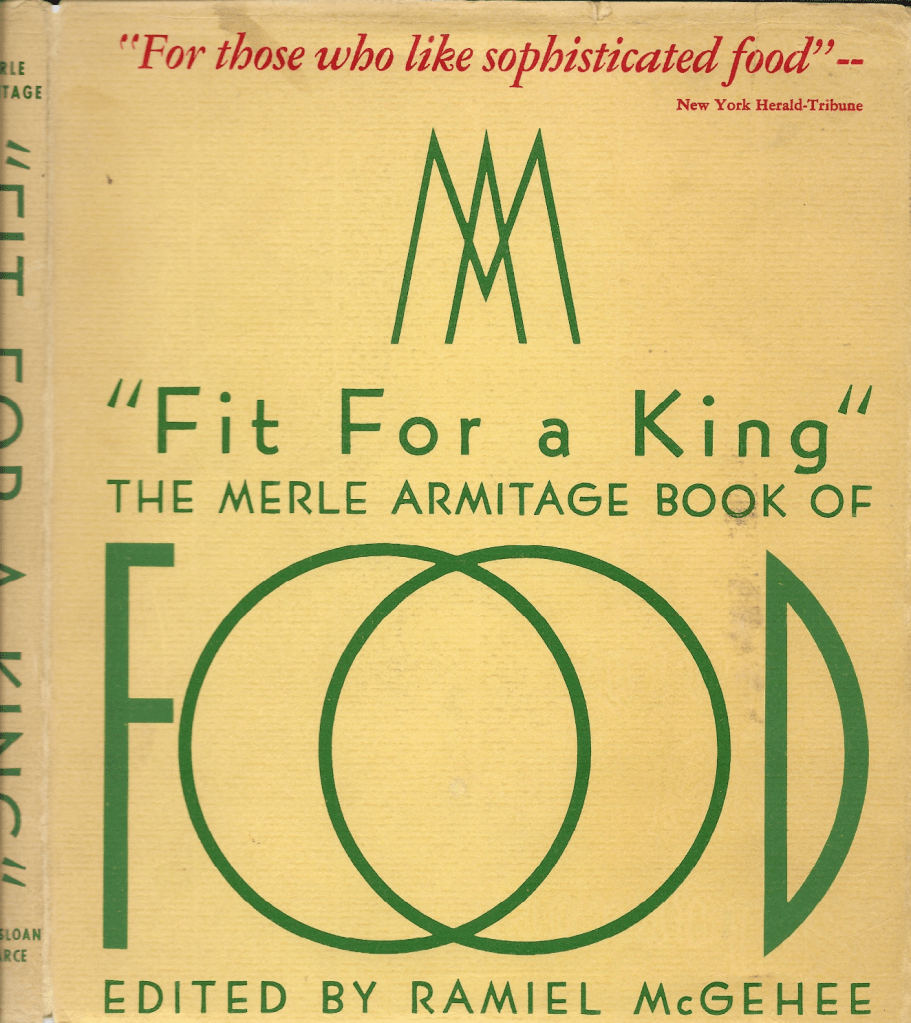
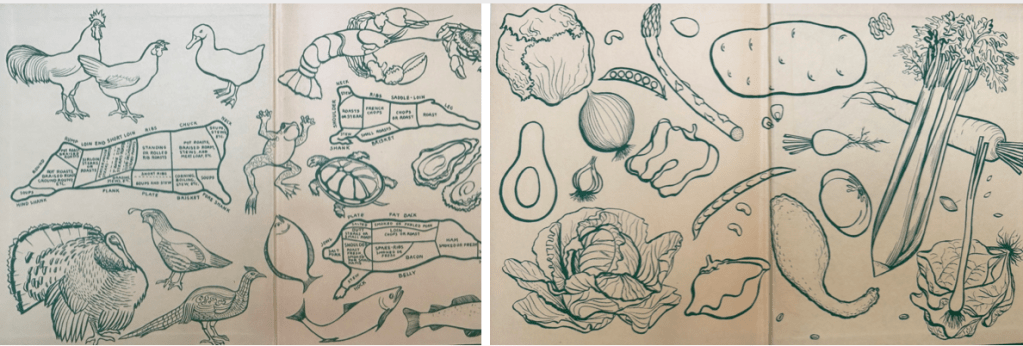
Nowhere does Weston’s fireside cuisine receive as delightful and unanticipated a tribute as in Merle Armitage’s eclectically urbane 1939 cookbook, “Fit for a King” The Merle Armitage Book of Food.[27] Edited by Weston’s and Armitage’s mutual friend Ramiel McGehee, this handsome publication is not only rich in recipes and erudite essays from famous chefs and cultural figures, it is enlivened with drawings by Elise,[28] endpapers by Carlos Dyer, and cover and title page lettering by William Stutz.
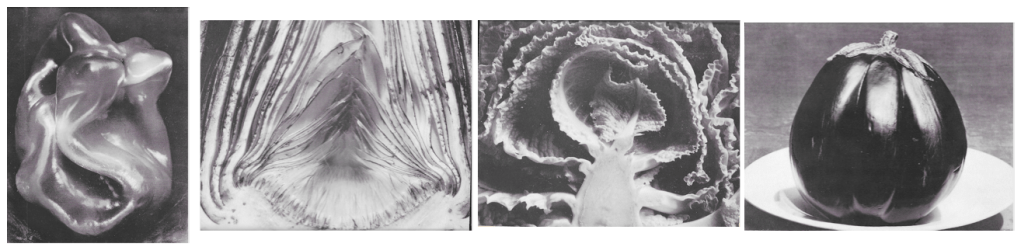
More to our point, the artistic contents also feature a special five-page pictorial titled “Edward Weston Presents: Four Vegetables.” These classic Weston photographs, Pepper, Artichoke Halved, Kale Halved and Eggplant, are each accorded a handsomely reproduced full page illustration.[29] In a later book on modern printing, Armitage explained: “… Some of Edward Weston’s photographs of the amazing forms of the more common vegetables were included so that people would really stop and look at nature’s magnificent constructions—a pleasure too often ignored.”[30]
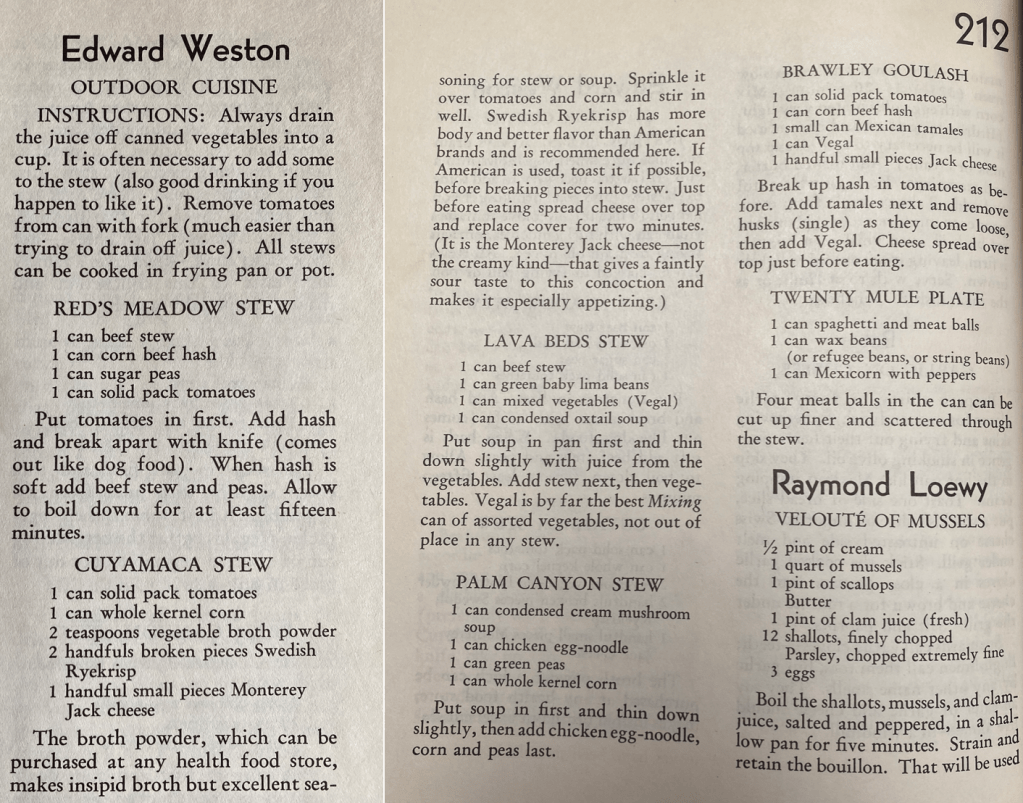
To enhance a cookbook with such iconic vegetable still lifes is hardly surprising, but Weston’s second contribution to Fit for a King certainly is. Nestled amongst the book’s haute cuisine, in a chapter titled “Inheritors of the ‘Cordon Bleu’”[31] is a selection of Weston’s camping recipes. Under the heading “Edward Weston Outdoor Cuisine” we find six decidedly non-epicurean, exceedingly simple, yet oddly appealing offerings. Comprised largely of canned ingredients, they are: “Red’s Meadow Stew,” Cuyamaca Stew,” Lava Beds Stew,” “Palm Canyon Stew,” “Brawley Goulash,” and “Twenty Mule Plate.”[32] Each pays homage to a location visited during the Guggenheim travels. Indeed, the genesis of “Red’s Meadow Stew” is noted in California and the West:
For three days more we kept to our mountain retreat. Mornings clear and sparkling; noons of gathering clouds; afternoons of thunder, lightning, and showers; evenings clear with clouds retreating over the peaks in wild sunset colors. Edward made at least twenty negatives each day: details of trees and stumps, rocks and snow; waterfalls cascading down the lightly forested slopes; pre-storm clouds and clearing clouds; Lake Ediza at sunset and at sunrise, soft light reflecting from the dark cliffs around it. / Then back to Agnew Meadow and over a couple of mountains to settle in the campground at Reds Meadow, which name we bestowed on the succulent stew that Edward devised that evening: a can of beef stew, a can of corned-beef hash, a can of tomatoes, and one of sugar peas, reduced in skillet by gentle simmering to suitable thickness.[33]
Why include canned food in Fit for a King? Because Armitage considered it a valid component of modern cookery:
But cooking with the can as aid, must and should be much more than purchasing, opening and heating its contents. A whole range of recipes have been built to utilize canned products in all their amazing variety. Even the man of cultivated palate has happy recourse to the can in deserts, jungles and other isolated places, and in hunting and fishing expeditions. The lowly and despised can very definitely has its place in the world of food, and will certainly be a factor in the food of tomorrow.[34]
Appreciative reviews for Fit for a King appeared from coast to coast. Some singled out Weston’s contributions, including these comments from Paul Jordan Smith in The Los Angeles Sunday Times on 5 November 1939:
“Fit for a King: the Merle Armitage Book of Food,” edited by Ramiel McGehee (Longmans,) is a sumptuous book, oozing richness and palpitant with temptation. Culinary authorities too numerous to mention, literary folk, dancers, actors, singers, epicures all, contribute recipes for their favorite dishes. And Edward Weston, great photographer, tempts us with photographs of winking vegetables. The Times-Mirror has made this fine cookbook into a volume of beauty; and philosophic essays on food and conversation serve to stimulate saliva, promote digestion and to keep the liver from enlarging too, too much. A man’s book of food that will make your mouth water.[35]
Among the more extensive critiques is this from the Fort Worth Star-Telegram, also on 5 November:
… along comes a most magnificent Merle Armitage opus glorifying good food and preparing a doctrine of giving greater thought and conversation to the matter of cooking and eating. It is a book of recipes interspersed with bits of literature in appreciation of good cooking and its by-product, hospitality, … / … Celebrities in the fields of various arts have contributed their favorite recipes, and famous professional chefs and cooks are represented, but required materials and procedure of preparation are for the most part entirely within the possibilities of the average grocery store and the average kitchen. / Foreign cookery forms an interesting section. … In contrast are the recipes which call only for skill in manipulating a can opener, such as Edward Weston’s offering, “Outdoor Cuisine,” based on combinations of from three to six different kinds of canned meats, stews, vegetables and soups. / … / There are formally arranged sections of soups, meats, fish, fowl, vegetables, sauces, salads and desserts, in addition to the mouth-watering miscellany made up of the contributions of “The Inheritors of the Cordon Bleu.” / … / Front page “portraits” of vegetables by Edward Weston are unusual extras.[36]
Ultimately, the practical simplicity of Weston’s recipes as well as his approach to camping and travel all reflect a creative spirit dedicated to achieving the finest photographic expressions possible through the most direct and practical means available. As Weston observed: “… all time saved by simplifying equipment and daily procedure meant more time for photographing. / … Time was too important to be wasted on cooking.”[37]
NOTES
1 Charis Wilson Weston and Edward Weston. California and the West. New York: (A U.S. Camera Book) Duell, Sloan and Pearce, 1940, Chapter 3, “Mojave and Colorado Deserts,” p. 49.
2 “Out-of-Town-Society: Miss Flora Chandler and Miss Emily Ellias…,” Los Angeles Sunday Times, 11 August 1907, Section VI, p. 8. For more information on Rincon Camp see the Homestead Museum blog: “The Homestead Blog: Creating Advocates for History Through the Stories of Greater Los Angeles”.
3 “Camping Days,” The Glendale News, 19 October 1907, unpaginated [8]. NOTE: The Packards are variously reported as “A.W.” and “W.A.” in different newspaper articles. However, A.W. Packard seems to be correct as a search of the Los Angeles Herald brings up numerous Society column references to A.W. Packard. Some of these references also mention the Marple family.
4 “Society: Engagement Announced.” Los Angeles Herald , 8 December 1907, Part II, p. 2. This brief Society column article reads: “Engagement Announced / Mr. and Mrs. C.C. Chandler of Tropico announce the engagement of their daughter, Miss Flora, to Edward Henry Weston of Chicago.”
5 “Marriages.” Los Angeles Sunday Times, 31 January 1909, 12. This notice in the “Marriages” column reads: “WESTON-CHANDLER. Edward H. Weston aged 23, a native of Illinois, and Flora M. Chandler, aged 30 a native of Illinois, both residents of Tropico.”
6 Weston clearly liked the way he appeared in this portrait, for he subsequently cropped his head and shoulder from the original photograph then enlarged and re-printed it as a self-portrait. This “Aesthetic” image, an appropriate reflection of the Pictorialist photographer he then was, was subsequently illustrated in a number of publications. He and Flora sent it as a Christmas greeting in 1911 (see: Karen Haas and Maggie Wessling, Edward Weston The Early Years, Boston: Museum of Fine Arts, Boston, 2018: Plate 8.); he submitted it to Photo-Era in 1912 (where it appeared in the October issue as the First Prize winner of their “Monthly Competition”); and in 1914 Weston included it as one of six photographs tipped into his own promotional brochure.
7 “Local Happenings: Mr. Edward Weston went to Lake Tahoe…,” The Tropico Interurban Sentinel [California], 19 July 1917, p. 8.
8 “Local Happenings: Home From the Wilds.” The Tropico Interurban Sentinel [California] (2 August 1917): p. 8.
9 Edward Weston. The Daybooks of Edward Weston. Vol. 1, Mexico. Edited by Nancy Newhall. Millerton, N.Y.: 1973. Entry made between 22 and 26 January 1924, p. 44. NOTE: Weston’s Daybook entry is undated and identified only as “Sunday.” In The Daybooks of Edward Weston, it falls between entries for January 22 and 26. However, the Eastman Museum records their photograph El Desierto de los Leones as inscribed verso: “Feb 3 – 1924.”
10 Edward Weston. The Daybooks of Edward Weston. Vol. 2, California. Edited by Nancy Newhall. Millerton, N.Y.: 1973. 11 April 1928, pp. 53-54.
11 Dr. Leo Eloesser was an acclaimed thoracic surgeon and innovator in the provision of rural and wartime health care. He was also a friend and patron of Diego Rivera and Frida Kahlo (for whom he provided medical treatment). See: Catherine Reef, “Leo and Frida The Doctor and the Artist, Stanford Medicine (Summer 2013) and “Portrait of Dr. Leo Eloesser and La Tortillera,” University of California San Francisco / Zuckerberg San Francisco General Hospital and Trauma Center.
12 Edward Weston. The Daybooks of Edward Weston. Vol. 2, California. Edited by Nancy Newhall. Millerton, N.Y.: 1973. 1 October 1928, p. 79.
13 Nancy Newhall, “Brett Weston,” Photo Notes [no vol./issue number], May–June 1947, pp. 3–4.
14 Edward Weston, “Photographing California [Part I],” Camera Craft 46:2, February 1939, pp. 56–64. p. 7.
15 Op. Cit. California and the West, Foreword, pp. 11–12.
16 Ibid., Chapter 1, pp. 22–23.
17 Ibid., Chapter 2, p. 50.
18 Ibid., Chapter 3, “Colorado Desert The Old Butterfield Stage Route,” pp. 60–61.
19 “ ‘Leaves of Grass’ Pictures Obtained,” The Arizona Daily Star [Tucson], 20 June 1941, 3.
20 Correspondence, Charis Wilson to Beatrice and Donald Prendergast, dated 19 September 1941; tl, unsigned, 2 sheets/2 pages. Collection of Paul M. Hertzmann.
21 Charis Wilson and Wendy Madar. Through Another Lens: My Years with Edward Weston. New York: North Point Press/Farrar, Straus and Giroux, 1998, p. 252.
22 Ibid., p. 251.
23 Ibid., p. 237.
24 Ibid., pp. 231–232.
25 Correspondence, Charis Wilson to Beatrice and Donald Prendergast, dated 21 August 1941; tl, unsigned, 3 sheets/3 pages. Collection of Paul M. Hertzmann.
26 Op. Cit. Through Another Lens, p. 277. Edward and Charis were Hanley’s guests at the end of September 1941.
27 Merle Armitage. Fit for a King, The Merle Armitage Book of Food. Edited by Ramiel McGehee, New York: Duell, Sloan and Pearce, 1939 [Revised Edition]. Fit for a King was originally published by Longmans, Green & Co., then soon re-published that same year by Duell, Sloan and Pearce. In their Preface to the book, Armitage and McGehee acknowledge the artists involved as follows: “SALUTE! / Because we love food, and cookery, design and typography, we have had an especially good time assembling this book. The valid relationship between sight and taste, here has a double meaning. The drawings at the chapter or section heads by Elise, the endpapers by Carlos Dyer, the lettering on cover and title page by William Stutz, and the Edward Weston photographs, have each been contributed by friends of this particular enterprise, this book of Food.”
28 Elise Cavanna Seeds Armitage Welton. Armitage’s previous wife prior to marrying Elsa Armitage. Elise was a former dancer, actress and comedian (who starred in films alongside W.C. Fields). She was also an accomplished artist whose modernist, abstract prints, paintings and drawings were highly regarded.
29 Op. Cit. Fit for a King, pp. 253–254.
30 Merle Armitage. Notes on Modern Printing. New York: William E. Rudge’s Sons, 1945, p. 52.
31 Ibid., p. 207. The full list of contributors to the chapter “Inheritors of the ‘Cordon Bleu’’ is (in order of appearance): Alfred Lunt; Angna Enters; Lewis Mumford; Gilbert Seldes; The Browns: Cora, Rose and Bob; Edward Weston; Raymond Loewy; Edgar Varèse; Rockwell Kent; Aline Bernstein; Louis Untermeyer; John Charles Thomas; Peppino Mangravite; G. Selmer Fougner; Jean Hersholt, Feodor Chaliapin; Richardson Wright; Julian Street; Murdock Pemberton; Richard Byrne of Scarletts, Beverly Hills; Roy L. Alciatore of Antoines, New Orleans; Helene Alciatore Cheer of La Louisiane, New Orleans; Louis Diat of the Ritz-Carleton, New York; and James M. Caine.
32 Ibid., pp. 211–212.
33 Op. Cit. California and the West, Chapter 5, p. 90.
34 Op. Cit. Fit for a King, p. 8.
35 Paul Jordan-Smith. “I’ll Be Judge You Be Jury: For the Palate.” Los Angeles Sunday Times, 5 November 1939, Part III, p. 7.
36 “A Cook Book to End All Cook Books.” Fort Worth Star-Telegram, 5 November 1939. Section 2, “Books and Bookmen News and Notes”, p. 7. NOTE: Although this review refers to Weston’s photographs as appearing “Front page” in Fit for a King, they are placed towards the conclusion of the book in the revised 1939 Duell, Sloan and Pearce publication used for this essay.
37 Op. Cit. “Photographing California [Part 1],” pp. 56–64.
 Edward Weston Bibliography
A particularly “tasty” addition to the bibliography. While the family business before me was the provisional of canned foods to corner grocery stores and later institutions, I think I will forego trying Weston’s recipes.
In appreciation,
Stephen Perloff Editor The Photo Review / The Photograph Collector 340 East Maple Avenue Suite 200 Langhorne, PA 19047 USA 215-891-0214 info@photoreview.org http://www.photoreview.org
>
LikeLike
Hi Stephen. I’m so glad you enjoyed this post. Personally, I wouldn’t mind trying Weston’s Brawley Goulash, although what “Vegal” is remains a mystery to me.
LikeLike